


Is Polyurethane Foam Filled Fender Durable?
12/04/2025What Is a Barrel Mooring Buoy?
12/08/2025Can tug boats handle rough seas?
Tug boats work in some of the toughest conditions at sea. Shipowners often ask if these small but powerful vessels can stay safe and effective when waves get high and winds get strong. The short answer is yes — but it depends on the type of tug boat, its design, and how the crew operates it.
In this article, we explain what affects a tug boat’s performance in rough seas and what shipowners should consider.
1. What Tug Boats Are Designed to Do
Tug boats are built for very specific jobs:
- Guiding ships during berthing and unberthing
- Towing barges, disabled ships, or offshore structures
- Escorting large vessels in narrow waterways
- Supporting rescue or salvage operations
Different tug boats serve different environments.
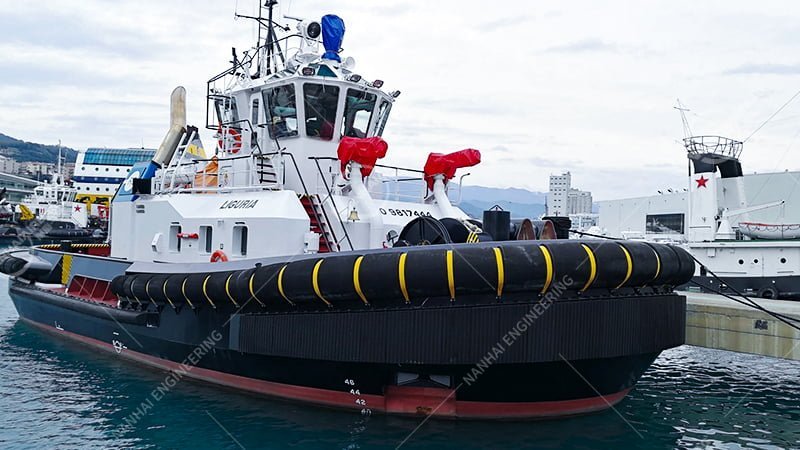
- Harbor tugs work close to shore.
- Ocean-going tugs are much stronger and designed to handle open-sea weather.
- AHTS vessels (Anchor Handling Tug Supply) support offshore platforms and deep-sea tasks.
Because each type is unique, not all tug boats can safely face the same sea conditions.
2. How Rough Seas Affect Tug Boats
Rough seas create several challenges for tug boats:
Wind
Strong winds reduce maneuverability and push the tug off course. This makes close-quarters operations riskier.
Waves
Large waves can cause the tug to roll, pitch, or slam into the troughs. If waves hit from the side, stability becomes a major concern.
Currents
Strong currents increase towing resistance and can put heavy stress on towlines.
Visibility
Fog, rain, and spray make communication and navigation harder.
Low temperature
Cold weather impacts deck safety, equipment performance, and towing gear.
Small harbor tug boats usually avoid extreme sea states, but ocean-going tugs are built to take on rough conditions with better stability and stronger power.
3. Why Some Tug Boats Handle Rough Seas Better Than Others
Several design features help tug boats perform well when the weather turns bad:
Hull shape and stability
A deeper hull and strong stability (GM) allow the tug to resist rolling and stay upright even in big waves.
Powerful engines
More horsepower means better control and stronger pulling force in high seas.
Azimuth thrusters
360-degree propulsion gives excellent maneuverability, which is crucial during towing.
Reinforced towing gear
High-strength towlines, winches, and shock-absorbing systems help handle sudden load changes when waves hit.
Safety equipment
Anti-slip decks, drainage, radar, and DP (Dynamic Positioning) systems help crews make smart decisions and stay safe.
For shipowners looking to hire or buy tug boats, these features matter a lot.
4. How Crews Operate Tug Boats Safely in Rough Seas
Even with strong design and equipment, good practice is essential.
Before operations
- Check weather forecasts
- Assess wave height, wind speed, and current
- Decide if conditions are safe enough for towing
During operations
- Keep towline tension steady
- Adjust towing length based on wave patterns
- Communicate constantly between vessels
- Choose a heading that reduces roll and slamming
Crew training
Well-trained crews know how to react when towlines snap, when steering becomes difficult, or when the vessel starts rolling too much.
Good seamanship often matters more than raw power.
5. Realistic Expectations for Shipowners
Tug boats can handle rough seas if they are built for it and operated by trained professionals. However:
- Harbor tugs should not work in open-sea storm conditions.
- Ocean-going tugs can operate in much higher sea states.
- Even the best tug boats have limits, and safety always comes first.
Shipowners should evaluate the tug’s class, power, towing gear, and crew experience before approving operations in rough weather.
Conclusion
Tug boats are tough, reliable, and surprisingly capable in heavy seas. But their performance depends on design, equipment, sea state, and the crew’s skills.
For safe and efficient operations, shipowners should choose the right type of tug boat and work closely with experienced operators who understand the risks of towing in rough waters.
FAQ
1. Can all tug boats work in rough seas?
No. Harbor tugs are not built for big waves. Ocean-going tugs and AHTS vessels perform much better in rough seas.
2. What features help tug boats stay stable?
Hull design, deep draft, strong engines, and azimuth thrusters all improve stability and control.
3. Do tug boats tow differently in rough weather?
Yes. Crews adjust towline length, heading, and speed to keep tension stable and avoid dangerous loads.
4. When should towing operations stop?
When wind, waves, or poor visibility create unsafe towing forces or reduce crew control. Safety should always come first.
5. How can shipowners choose the right tug boat?
Check the vessel’s type, horsepower, towing equipment, maintenance record, and crew qualifications.