



Port Congestion Surge: What It Means for Shipping and Maritime Operations
03/30/2026Types of Marine Salvage: A Practical Guide to Modern Salvage Operations
04/07/2026What Tools Are Used in Ship Building?
Introduction
Shipbuilding is a complex industrial process that combines engineering, heavy machinery, and skilled labor. Modern shipyards rely on a wide range of specialized tools to design, fabricate, assemble, and launch vessels efficiently and safely.
From steel cutting machines to advanced welding systems and launching equipment, each tool plays a critical role in ensuring structural integrity and production efficiency. In many regions such as East Asia, Southeast Asia, and South Asia, cost-effective and flexible construction methods are widely adopted, including the increasing use of ship launching airbags.
1. Cutting and Fabrication Tools
The first step in shipbuilding involves preparing raw materials, mainly steel plates and sections.
Common tools include:
- CNC cutting machines for precision shaping
- Plasma cutting systems for fast and accurate cuts
- Oxy-fuel cutting equipment for thick steel plates
- Angle grinders and portable cutters for manual adjustments
These tools ensure that every component fits precisely during assembly, reducing errors and rework.
2. Welding Equipment
Welding is the backbone of ship construction, as it permanently joins metal parts together.
Key welding tools include:
- Shielded Metal Arc Welding (SMAW) machines
- Gas Metal Arc Welding (MIG/MAG) systems
- Tungsten Inert Gas (TIG) welding equipment
- Automated and robotic welding systems
Shipyards often use a combination of manual and automated welding to balance flexibility and productivity.
3. Measuring and Inspection Tools
Accuracy is critical in shipbuilding. Even small deviations can affect performance and safety.
Common inspection tools:
- Laser distance meters
- Spirit levels and theodolites
- Ultrasonic testing (UT) devices
- Thickness gauges for material inspection
Non-destructive testing (NDT) methods are widely used to detect internal defects without damaging the structure.
4. Lifting and Material Handling Equipment
Ship components can be extremely large and heavy, requiring powerful lifting systems.
Typical equipment includes:
- Gantry cranes
- Overhead cranes
- Mobile cranes
- Forklifts and transporters
These tools help move steel blocks, modules, and completed sections across the shipyard safely.
5. Block Assembly and Alignment Tools
Modern shipbuilding often uses modular construction, where ships are built in sections (blocks) and later assembled.
Tools used in this stage:
- Hydraulic jacks
- Alignment jigs and fixtures
- Support blocks and scaffolding
- Positioning systems for precise joining
These ensure that large sections align correctly before final welding.
6. Ship Launching Equipment and Methods
Launching is one of the most critical phases in shipbuilding. It involves transferring the vessel from land to water.
Traditional methods include:
- Dry docks
- Floating docks
- Slipways
Ship Launching Airbags
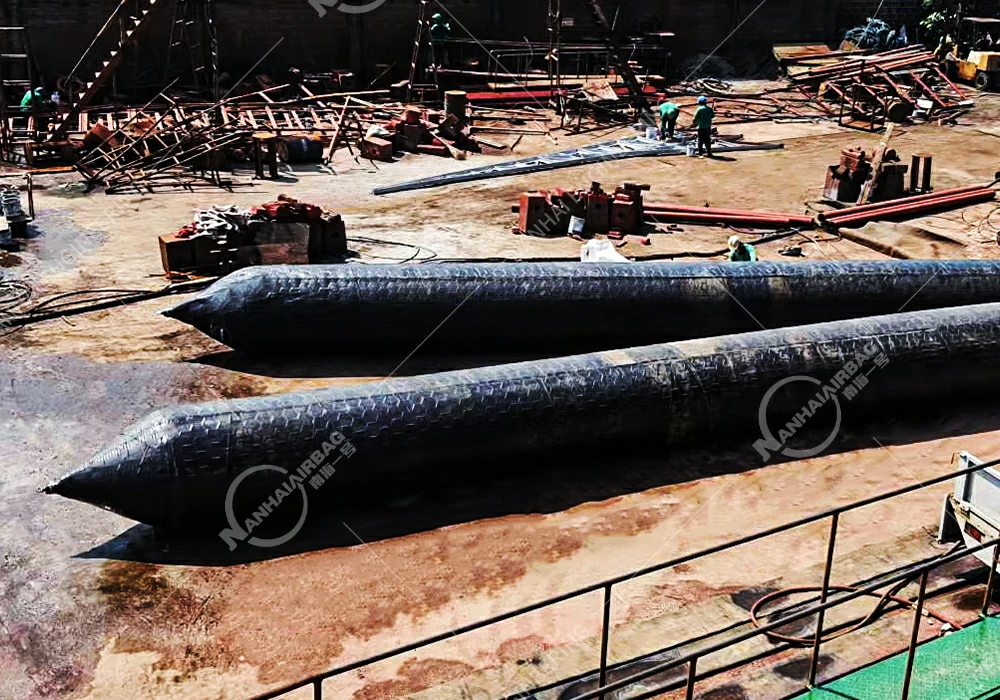
A widely used modern method in regions such as East Asia, Southeast Asia, and South Asia is the use of ship launching airbags.
These heavy-duty rubber airbags are placed under the hull and inflated to support and roll the vessel into the water.
Advantages of ship launching airbags:
- Cost-effective compared to dry docks
- Reusable and flexible
- Suitable for shipyards with limited infrastructure
- Ideal for small to medium-sized vessels
This method has become particularly popular in developing shipbuilding regions where investment in large-scale dry dock facilities may be limited.


7. Auxiliary Tools and Safety Equipment
Safety and support systems are essential in shipbuilding environments.
These include:
- Power tools (electric and pneumatic)
- Personal protective equipment (PPE) such as helmets, gloves, and goggles
- Ventilation and dust control systems
- Fire prevention and emergency systems
These tools protect workers and maintain a safe working environment.
8. Trends in Modern Shipbuilding Tools
The shipbuilding industry continues to evolve with technology.
Key trends include:
- Increased automation and robotics
- Digital design tools (CAD/CAM systems)
- Smart shipyard management systems
- Advanced inspection technologies
- Wider adoption of flexible launching solutions like airbags
These innovations improve efficiency, reduce labor costs, and enhance build quality.
Conclusion
Shipbuilding requires a diverse set of tools that work together across multiple stages of construction. From cutting and welding to lifting, assembly, and launching, each category of equipment plays a vital role in delivering a seaworthy vessel.
In particular, ship launching airbags have become an important solution in regions such as East Asia, Southeast Asia, and South Asia, offering a practical and economical alternative to traditional launching methods. As the industry continues to modernize, the integration of advanced tools and techniques will further improve productivity and safety in shipyards worldwide.
FAQ
1. What are the most important tools in shipbuilding?
The most important tools include cutting machines, welding equipment, cranes, measuring instruments, and assembly tools used throughout the construction process.
2. Why is welding important in shipbuilding?
Welding permanently joins steel components, forming the structural framework of the ship and ensuring durability and strength.
3. What is a ship launching airbag?
A ship launching airbag is a large inflatable rubber device used to roll and support a vessel during its launch from land into water.
4. Where are ship launching airbags commonly used?
They are widely used in regions such as East Asia, Southeast Asia, and South Asia, especially in shipyards with limited infrastructure.
5. Are ship launching airbags safe?
Yes, when properly designed and used according to guidelines, they provide a safe and efficient method for launching vessels.