


What happens if you see a buoy?
11/26/2025Why Are Ships Launched with Champagne?
11/28/2025What do donut fenders do?
Introduction
If you design or operate a port, you know that protecting your berths and vessels is crucial. Donut fenders play a key role in keeping ships safe while docking. They absorb energy, reduce stress on both vessels and piers, and adapt to tides and ship movements. In this article, we’ll explore how donut fenders work, why they are useful, and how to choose the right ones for your port. We’ll also highlight NANHAI’s solutions for modern ports.
What Are Donut Fenders?
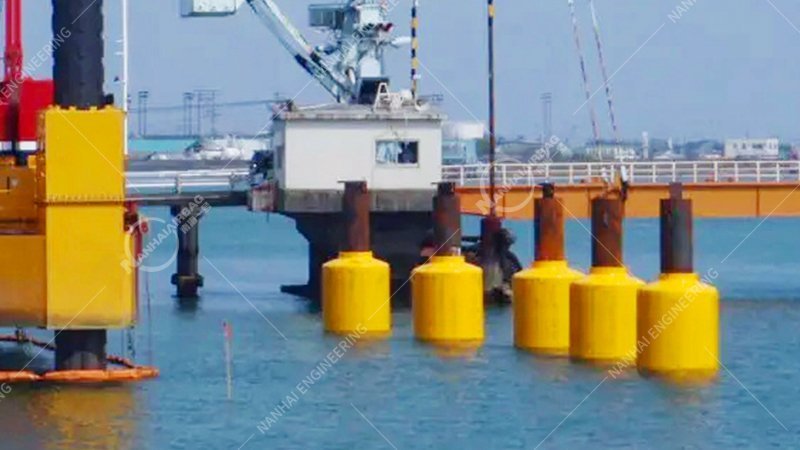
Donut fenders are ring-shaped fenders that fit around a single pile or monopile. They are designed to rotate and float freely, which allows them to follow tide changes and align with moving ships. Typically, a donut fender has:
- A foam core for energy absorption
- A durable outer layer, usually polyurethane or reinforced rubber
- A low-friction lining (like UHMW-PE) to allow smooth rotation around a pile
These features let donut fenders absorb impact while reducing the force transferred to the pier or ship. Unlike traditional cylindrical or pile-wrap fenders, donut fenders can rotate, self-align, and maintain full contact with the vessel at different water levels.
Typical Applications
Donut fenders are popular in modern port design, especially where precise ship guidance is required. Common applications include:
- Turning dolphins or lead-in piles, where ships need guidance into tight berths
- High tidal areas, where the fender must follow the changing water level
- Berths for sensitive vessels, like ferries, cruise ships, or LNG carriers, where low reaction forces are crucial
Because they rotate and absorb energy effectively, donut fenders reduce the risk of damage to both ships and piers. They also help ports handle different ship sizes without needing frequent adjustments.
Design and Selection Tips
When choosing donut fenders, consider these factors:
- Energy absorption: Make sure the fender can handle the kinetic energy of the vessel at berthing speed.
- Maximum reaction force: The fender should not exceed the pier’s or ship’s structural limits.
- Tide range: Select a fender that floats and rotates properly over the expected water level variations.
- Ship type and size: Match the fender diameter and thickness to the largest ships you expect.
- Materials: Use durable polyurethane or reinforced rubber with a low-friction inner lining for long service life.
Tip: Donut fenders often outperform cylindrical fenders or pile-wrap fenders in tidal areas or on turning dolphins, because they rotate and maintain full contact automatically.

Structure and Materials
A typical donut fender consists of:
- Closed-cell foam core: Light, buoyant, and highly energy-absorbing
- Outer layer: Polyurethane or reinforced rubber, resistant to wear, UV, and saltwater
- Inner lining: Low-friction material like UHMW-PE or nylon, allowing smooth rotation around the pile
- Optional steel reinforcement: For very large berths, a steel insert can increase strength without compromising rotation
This combination ensures that the fender can handle repeated impacts over years without significant deformation or damage.
Installation and Maintenance
Proper installation and regular maintenance are key to long-lasting performance:
- Installation: Slide the donut fender onto a pre-installed pile. Ensure the low-friction lining is correctly seated to allow smooth rotation. No welding is required in most cases.
- Inspection checklist:
- Check outer layer for wear, cracks, or cuts
- Ensure low-friction lining rotates freely
- Inspect foam core for compression or deformation
- Verify bolts or anchors are secure
- Maintenance tips:
- Avoid contact with sharp edges or ropes
- Replace worn linings promptly
- Rinse with fresh water to reduce salt and dirt buildup
With proper care, donut fenders can last 10+ years, even in high-traffic ports.
Design Cases
Here are two examples of donut fender applications:
- Ferry Terminal in a Tidal Port: Donut fenders on turning dolphins allowed ferries to dock safely at any tide level. Energy absorption calculations ensured pier protection without overloading structures.
- LNG Receiving Berth: Large donut fenders rotated freely on monopiles, guiding ships accurately while keeping reaction forces low. Polyurethane outer layers resisted wear from ice and ropes.
In both cases, NANHAI’s custom-designed donut fenders provided reliable performance with minimal maintenance.
Summary
Donut fenders are essential for modern ports with variable tides and precise docking needs. They absorb energy, reduce stress, rotate around piles, and adapt to water level changes. For port designers and operators, donut fenders are a practical choice for turning dolphins, tidal berths, and sensitive vessel operations. With proper design and maintenance, NANHAI donut fenders offer long-lasting, low-maintenance solutions for modern ports.
FAQ
Q1: Can donut fenders be used in all tidal conditions?
A1: Yes, they are especially effective in areas with large tide variations because they float and rotate with the water level.
Q2: How do donut fenders reduce reaction forces on piers?
A2: Their foam core absorbs energy while their rotation allows the ship to slide slightly, reducing peak forces on the pier.
Q3: What maintenance is required for donut fenders?
A3: Inspect the outer layer for wear, ensure the inner lining rotates freely, check the foam core for deformation, and rinse regularly with fresh water.
Q4: How long do donut fenders last?
A4: With proper installation and maintenance, they can last 10+ years in most ports.
Q5: Can they handle large vessels like LNG carriers?
A5: Yes, properly sized donut fenders with durable materials and optional steel reinforcement can handle very large ships safely.