


Types of Marine Salvage: A Practical Guide to Modern Salvage Operations
04/07/2026Marine Fender Procurement: Essential Certifications to Guarantee Quality
04/22/2026Cone Rubber Fender: Key Advantages in Marine Docking Operations
When a vessel approaches a berth, the impact is rarely gentle. Wind, current, and small navigation errors can turn a routine docking into a high-energy event. In busy ports, this repeated stress can damage both the ship hull and the quay structure.
A cone rubber fender is designed to manage exactly this kind of impact. It absorbs large amounts of berthing energy while keeping reaction forces low, helping protect both vessels and port infrastructure.
In this guide, we’ll explain how cone rubber fenders work, why they outperform traditional systems, and how to choose the right model for your project.
Understanding Cone Rubber Fenders in Modern Marine Docking
A cone rubber fender is a high-performance marine fender system used to absorb the energy generated when a vessel berths. It is widely considered the third generation of fixed rubber fenders, evolving from earlier cell fender designs.
The key feature is its conical shape. Unlike cylindrical or cell fenders, the cone structure compresses more efficiently under load. This allows it to deliver higher energy absorption while keeping reaction forces under control.
How Is It Structured?
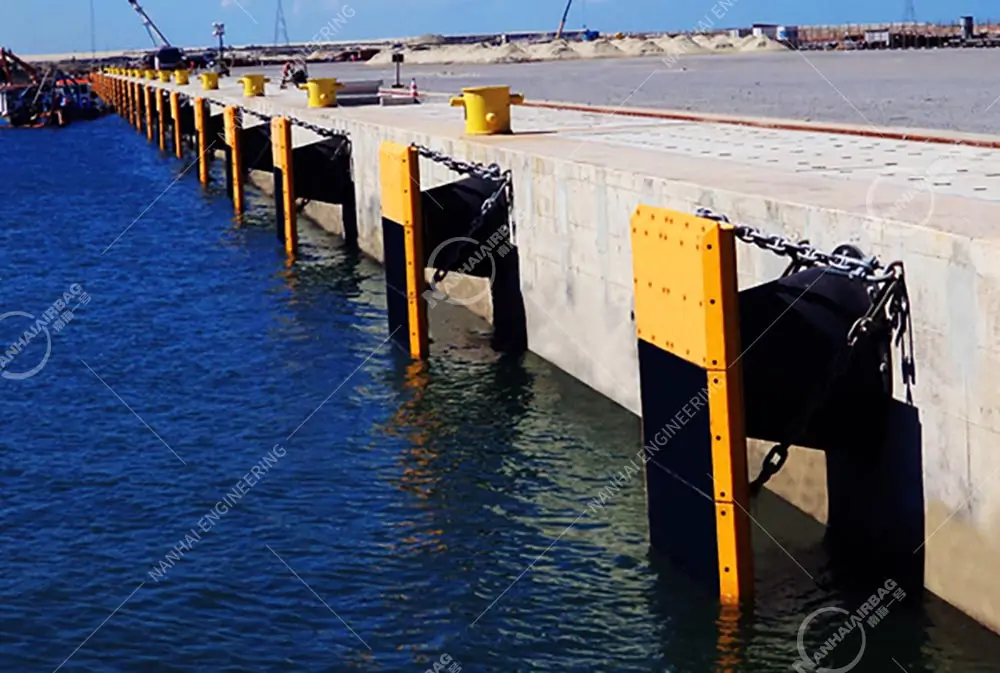
- Cone body: The main rubber element that compresses under impact and absorbs energy
- Mounting base plate: Secures the fender to the quay wall or structure
- Frontal frame: Distributes load across the fender face
- UHMW-PE panel: Provides a low-friction surface to reduce hull wear

7 Key Advantages of Cone Rubber Fenders in Marine Docking
1. Superior Energy Absorption Performance
The conical geometry allows the fender to deform in a controlled way. This maximizes energy absorption compared to traditional cell fenders of similar size. For high-tonnage vessels, this difference becomes critical.
2. Low Hull Reaction Force
A key performance metric is the reaction force to energy ratio (R/E). Cone fenders offer a lower R/E ratio, meaning they absorb more energy while applying less force back onto the vessel and quay.
This reduces structural stress and helps extend the life of both the ship and the berth.
3. Excellent Angular Compression Tolerance
In real docking conditions, vessels rarely hit the berth straight on. Cone fenders can handle compression angles of up to ±10° with minimal performance loss.
This makes them ideal for ports exposed to wind, waves, or strong currents.
4. Long Service Life and Durability
Cone fenders are made from high-quality rubber compounds such as natural rubber or EPDM. These materials resist seawater, UV exposure, and ozone damage.
In most installations, the service life ranges from 15 to 20 years.
5. Versatile Installation and Configuration Options
Cone fenders can be used with different frontal panels and mounting systems. They work well with:
- Concrete quay walls
- Steel structures
- Floating docks
This flexibility makes them suitable for both new projects and retrofits.
6. Minimal Maintenance Requirements
Unlike pneumatic systems, cone fenders do not require air pressure monitoring or inflation. They have no moving parts, which reduces the risk of failure.
Routine inspection is usually enough to keep them in good condition.
7. Compliance with International Standards
Cone rubber fenders are typically designed according to PIANC guidelines and relevant ISO standards. This ensures they meet the requirements for modern port engineering and tender specifications.
Cone Rubber Fender vs Other Fender Types
Different fender systems are designed for different applications. Choosing the right one depends on vessel size, berthing conditions, and project requirements.
| Feature | Cone Fender | Cell Fender | Cylindrical Fender | Arch Fender |
|---|---|---|---|---|
| Energy Absorption | High | Medium | Low | Medium |
| Reaction Force | Low | Medium | High | Medium |
| Angular Tolerance | High | Medium | Low | Low |
| Service Life | 15–20 yrs | 12–18 yrs | 10–15 yrs | 10–15 yrs |
| Maintenance | Low | Low | Medium | Low |
| Best For | Large vessels, high energy | General cargo | Small docks | Medium berths |
Overall, cone fenders provide the best balance of performance and durability for high-energy berthing operations.
How to Select the Right Cone Rubber Fender for Your Berth
Selecting the correct fender requires understanding your vessel and operating conditions.
Key Parameters to Consider
- Vessel displacement (DWT): Larger ships generate more berthing energy
- Berthing velocity: Higher speed increases impact force
- Berthing angle: Affects how force is distributed
- Tidal range and clearance: Determines fender positioning
- Berth structure type: Impacts installation method
- Required energy absorption: Must match calculated berthing energy
A Simple Sizing Example
For a 10,000 DWT bulk carrier, the berthing energy depends on approach speed and angle. Even at moderate speed, the energy can reach several hundred kJ.
In this case, a cone fender with sufficient rated energy absorption should be selected to ensure safe docking without overstressing the structure.
Not sure which size fits your project? Contact our engineering team for a free specification review.
Typical Applications of Cone Rubber Fenders
- Container terminals: Handle frequent, high-energy berthing
- Oil & gas jetties: Require reliable and safe energy absorption
- RoRo berths: Deal with varying vessel sizes and angles
- Offshore platforms: Operate under harsh marine conditions
- Naval bases: Demand high durability and performance
Frequently Asked Questions
Q: What is a cone rubber fender used for?
It is used to absorb the impact energy when ships dock, protecting both the vessel and the port structure.
Q: How does it absorb energy?
The cone shape compresses under load, converting kinetic energy into deformation energy in the rubber.
Q: Cone vs cell fender?
Cone fenders provide higher energy absorption and lower reaction force, making them better for large vessels.
Q: How long do they last?
Typically 15–20 years, depending on usage and environment.
Q: What size do I need?
It depends on vessel size, speed, and docking conditions. Engineering calculations are required.
Q: Are they PIANC compliant?
Yes, most cone fenders are designed according to PIANC guidelines.
Conclusion
Cone rubber fenders offer a strong combination of high energy absorption, low reaction force, and long service life. For ports handling large vessels or high berthing energy, they are often the most reliable solution.
If you are planning a new project or upgrading an existing berth, choosing the right cone rubber fender can significantly improve safety and reduce long-term costs.