


What Is a Barrel Mooring Buoy?
12/08/2025How to Avoid Ship Launching Risks – Ship Launching Airbags
12/12/2025How Is Oil Transferred at Sea?
Moving oil at sea is a key part of global energy logistics. When large tankers cannot enter ports or when offshore oil fields need to load crude directly onto ships, operators use several offshore transfer methods. The two most common ways are Ship-to-Ship (STS) transfer and Single Point Mooring (SPM) transfer, and both help keep the oil supply chain fast and flexible.
1. Ship-to-Ship (STS) Transfer
Ship-to-Ship transfer happens when two tankers stay side by side on open water and move oil through transfer hoses. This method is widely used when very large crude carriers (VLCCs) cannot enter shallow ports.
To safely bring two huge ships close together, crews place pneumatic fenders between them. These are large air-filled marine fenders designed to absorb strong impact forces. They keep both hulls separated, even when waves push the vessels. Without these fenders, STS operations would carry a high risk of damage.
Once the ships are secure, operators connect the hoses and start pumping crude from one vessel to the other. During the entire transfer, the team monitors pressure, flow rate, and ship movement to avoid leaks or overload. When the job is done, the hoses and fenders are removed, and both vessels continue their voyages.
STS transfer is popular because it is fast, flexible, and not limited by port schedules.
2. Single Point Mooring (SPM) Transfer
Another major offshore transfer method is the Single Point Mooring (SPM) system. An SPM looks like a large floating mooring buoy anchored to the seabed. It is connected to underwater pipelines that bring crude oil from an offshore field or a coastal storage facility.
When a tanker arrives, it secures its mooring lines to the buoy. The buoy has a rotating design, so the ship can naturally turn with wind and waves while staying safely attached. After mooring, operators connect floating hoses from the buoy to the tanker’s deck manifold.
Oil then flows from the seabed pipeline → through the SPM buoy → into the hoses → and finally into the tanker.
SPM systems work well in deep water and remote areas where building a full port terminal is not possible.
3. FPSO Offloading
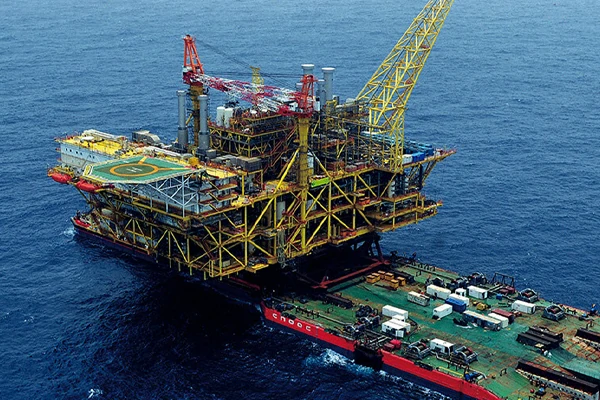
In many offshore oil fields, companies use FPSO units (Floating Production, Storage, and Offloading). These floating facilities process, store, and offload crude oil at sea.
When the FPSO storage tanks start to fill up, a shuttle tanker comes alongside. The FPSO connects floating hoses and pumps oil directly to the tanker. While similar to SPM operations, FPSOs act as both production and temporary storage units, making them ideal for deepwater locations.
4. Safety and Environmental Control
Safety is critical in all offshore transfers. Operators track ship position, weather changes, and pump pressure in real time. Oil booms are kept ready in case of a spill, and operations stop during strong winds or rough seas.
International rules such as MARPOL and OCIMF guidelines ensure clean, controlled, and reliable offshore oil handling.
FAQ
1. Why is STS transfer used instead of docking at a port?
Many large tankers are too deep to enter ports, so STS allows them to transfer oil offshore without delays.
2. What equipment keeps ships safe during STS?
Pneumatic fenders act as a strong air-filled buffer and prevent the ships from hitting each other.
3. What is the main function of an SPM buoy?
The buoy connects the tanker to subsea pipelines and allows the ship to rotate freely while loading crude.
4. Is offshore oil transfer safe?
Yes. With trained crews, strong fenders, modern hoses, and strict rules, offshore transfers are safe and well-controlled.