


Understanding Floating Fenders – How Do They Work?
02/24/2026When Do You Need Double-Row Marine Airbags for Ship Launching?
02/28/2026How Do Foam Fenders Protect Ships?
Foam fenders are safety devices used in ships and ports. They help protect ships when they come close to a dock, another ship, or other hard objects. Foam fenders are usually made of a strong foam core with a tough outer layer. They can float on water and absorb shock very well.
Foam fenders play an important role in keeping ships and port facilities safe.
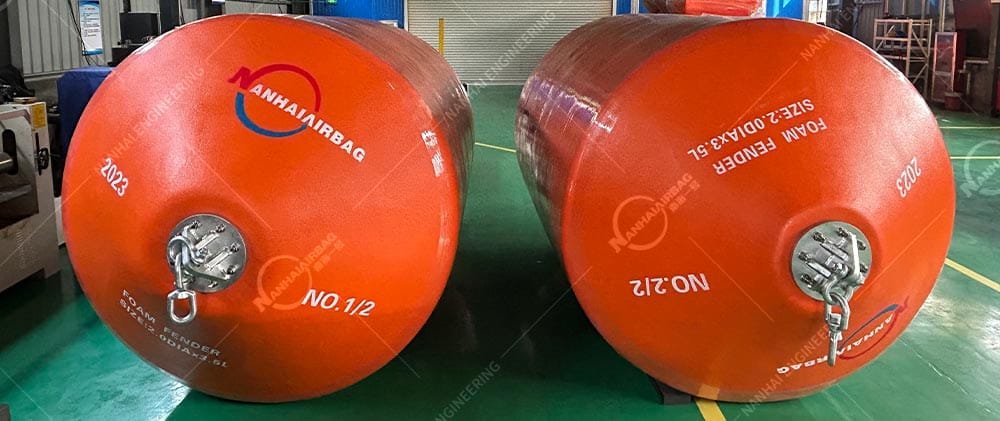
1. They Absorb Impact Energy
The main job of a foam fender is to absorb impact energy.
When a ship moves toward a dock or another ship, it may hit with strong force. The foam inside the fender compresses (squeezes down) and absorbs much of this force. This reduces the pressure on the ship’s body.
Foam fenders also create less rebound force compared to solid rubber fenders. This means the ship is less likely to bounce back and hit again. Because of this, foam fenders help:
- Reduce damage to the ship’s hull
- Lower repair costs
- Extend the life of the ship
2. They Resist Water and Corrosion
Foam fenders are made with closed-cell foam. This means water cannot easily enter the inside material. Even if the outer layer is damaged, the foam does not absorb much water.
The outer coating is usually made of strong materials like polyurethane or rubber. These materials can resist:
- Saltwater
- Sunlight (UV rays)
- Rain and humidity
- Temperature changes
Because of this, foam fenders can be used for a long time in sea and river environments.
3. They Are Lightweight and Easy to Install
Foam fenders are lighter than many traditional steel or solid rubber fenders. This makes them easier to move and install.
They can be made in different sizes to fit different ships and docks. Foam fenders are often used in:
- Commercial ports
- Oil and gas terminals
- Ship-to-ship (STS) operations
- Floating platforms
- Yacht marinas
Their flexibility makes port operations safer and more efficient.
4. They Improve Safety
In busy ports, ships dock many times each day. In rough weather, docking can be even more dangerous. Foam fenders provide steady protection during these operations.
By reducing impact force, they lower the risk of:
- Structural damage
- Expensive repairs
- Delays in shipping
For high-value ships and port facilities, foam fenders are an important safety solution.
Conclusion
Foam fenders are very important in modern shipping and port operations. They absorb impact energy, resist water and corrosion, and are easy to install. Because of their strong performance and long service life, foam fenders are widely used to protect ships and docks around the world.
FAQ
1. What is a foam fender made of?
A foam fender is made of a strong foam core and a tough outer layer. The foam absorbs impact, and the outer layer protects it from water and damage.
2. How do foam fenders protect ships?
They absorb the energy from impacts when a ship docks or contacts another ship. This reduces damage to the ship’s hull.
3. Are foam fenders waterproof?
Yes. Most foam fenders use closed-cell foam, which does not easily absorb water. The outer coating also protects against water and salt.
4. Where are foam fenders commonly used?
They are used in ports, oil terminals, ship-to-ship operations, floating platforms, and marinas.
5. Why choose foam fenders instead of rubber fenders?
Foam fenders often create less rebound force and provide stable performance. They are also lightweight and resistant to corrosion.