



What is the meaning of offshore wind?
09/01/2025Preparing for Ship Launching Airbags
09/03/2025Arch Fenders Buying Guide 2025
1. 2025 Purchase Trends
In 2025, the arch fenders market shows three key trends:
Performance Guarantee Becomes Standard
More manufacturers now provide Guaranteed Performance, not just “typical values.”
This means that at 50% compression, the energy absorption (EA) and reaction force (RF) must meet contract requirements. It reduces the risk of fake or exaggerated performance claims.
Better Materials & Longer Service Life
NANHAI New-generation arch fenders use special rubber compounds that resist low temperature, aging, and oil.
- Working temperature range: -50°C to +70°C
- Improved hot vulcanization and stress design reduce early cracking risks.
Traceability & Green Solutions
- Each fender has a QR code to track production batch and compression data.
- Bolt and panel coatings now meet ISO C5-M for anti-corrosion in salty environments.
Summary:
When buying arch fenders in 2025, don’t focus only on price. Pay attention to performance transparency, material upgrades, and traceability.

2. When to Choose Arch Fenders
| Scenario | Recommendation | Reason |
|---|---|---|
| Small- to medium-size ships | Best choice | Moderate energy, low cost, easy to maintain |
| Barges, fishing boats, tugs | Recommended | Frequent berthing, low-speed impacts |
| Large container ships, VLCC | Be cautious | High energy demand → consider cone or cell fenders |
| LNG or gas terminals | Not suitable | High shear force, better use pneumatic fenders |
| Ports with large tides | Be cautious | Must match fender energy curve and panel height |
Summary:
Arch fenders are best for low-speed berthing, medium energy levels, and frequent operations.
For very large ships, high shear angles, or big tidal ranges, use cone fenders or cell fenders instead.

3. How to Select the Right Model
Step 1. Collect Design Data
- Ship type, displacement, berthing speed
- Tidal range, berth structure, max reaction force allowed
- Berthing angle and shear force
Step 2. Calculate Berthing Energy
Use this simplified formula: E=12×M×V2×CE = \frac{1}{2} \times M \times V^2 \times CE=21×M×V2×C
Where:
- E = berthing energy (kN·m)
- M = ship mass
- V = berthing speed
- C = safety factor
Step 3. Define Fender Performance
- EA (Energy Absorption): energy absorbed at design compression
- RF (Reaction Force): maximum force on the structure
Make sure:
- EA ≥ ship energy
- RF ≤ berth structure limit
Step 4. Check Fender Layout
- Ensure enough fenders to handle total energy
- Keep equal spacing to avoid unprotected gaps
Step 5. Match Accessories
- Panels & pads: use UHMW-PE to reduce friction
- Bolts & backing plates: follow ISO 898 or ASTM A325 strength standards
- Corrosion protection: choose coatings tested for ≥1000 hours salt spray
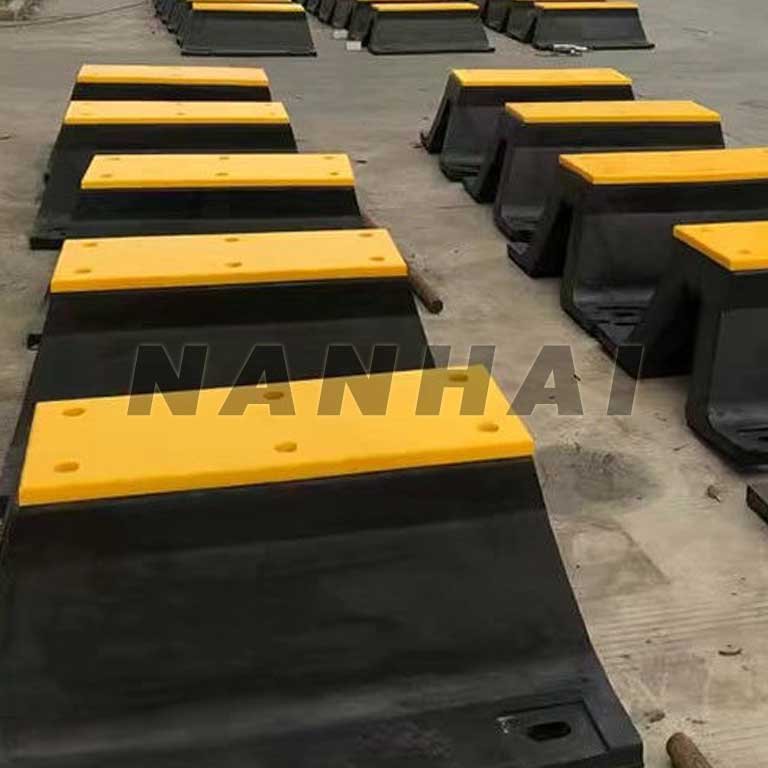
4. Key Technical Parameters Explained
| Parameter | Meaning | Impact on Selection |
|---|---|---|
| EA | Energy absorption (kN·m) | Higher EA = better shock protection |
| RF | Reaction force (kN) | Lower RF = safer for berth walls |
| Compression | Usually 50% | Over-compression risks damage |
| Hardness | Rubber hardness (Shore A) | Typical: 55±5; affects EA/RF balance |
| Aging/Ozone Resistance | ASTM D1149 / ISO 1431 | Needed for harsh marine climates |
| UHMW-PE Pad | 20–40 mm thickness | Low friction and better wear resistance |
Tip:
When writing purchase specs, always include EA, RF, compression rate, rubber properties, and panel material.
Missing data may cause performance failures after installation.
5. Fender Layout & Installation
- Spacing: Follow China JTS 167-2013 Port Design Code to avoid interference.
- Anchor bolts & backing plates:
- Use hot-dip galvanized high-strength bolts
- Embed depth ≥ 15 × bolt diameter
- Installation steps:
- Clean berth wall and check pre-drilled holes
- Install backing plate and fender body
- Tighten bolts evenly, control torque
- Check panel alignment and height
6. Quality Control & Acceptance
Documents to Request
- Rubber material statement
- Compression test curves (EA & RF)
- Factory inspection certificates
On-site Inspection
- Visual check: no cracks, no missing rubber
- Dimension check: height, width, bolt holes
- Random compression test: confirm EA/RF values
Third-Party Witness
Choose CCS, BV, or DNV for independent performance verification.
7. Contract & Business Terms
- Supply scope: fender body, backing plate, bolts, panels, accessories
- Packaging: pallet + moisture-proof film, QR code tracking
- Warranty & after-sales:
- At least 12 months warranty
- Include on-site installation support
- Payment & risk control:
- Define penalties for under-performance
- For big projects, request batch delivery and price lock
8. Comparison with Other Fender Types
| Type | Features | Best Use |
|---|---|---|
| Arch | Low cost, easy install | Small to medium ships |
| D-type fenders | Softer, flexible | Tugs, barges, workboats |
| Cell fenders | High energy, angle friendly | Multipurpose berths |
| Cone fenders | High energy, low RF, anti-shear | Large ship berths |
| Cylindrical rubber fenders | Stable, good for frequent use | Container & bulk ports |
9. Purchase “Red Flags”
- ❌ Only gives typical values, no guaranteed values
- ❌ No full compression curves or test reports
- ❌ Missing rubber durability data
- ❌ Panel bolts exposed → pad damage risk
- ❌ Bolt layout doesn’t match berth drawings → rework required
10. FAQs
Q1: Why are EA/RF different for the same height but different series?
A: High-energy models (HA series) have higher EA and optimized RF. Always check the performance curve, not just size.
Q2: Do low temperatures affect arch fenders?
A: Yes. Standard rubber gets hard below -20°C. Use low-temperature rubber compounds for cold areas.
Q3: Can I reuse old bolt holes when upgrading fenders?
A: Yes, if model and spacing match, but always recalculate EA/RF to avoid overloading structures.