



When Should You Put Pneumatic Fenders on Your Ship?
12/23/2025How Are the Inner Rubber Layer and Cord Fabric Layers Built in Ship Launching Airbags?
12/25/2025Low-Temperature Marine Fender Solutions
As Arctic routes open, cold-region ports expand, and winter operations become normal, more vessels now need to berth and operate in very low or even extreme cold environments.
What many people overlook is this: low temperature affects marine fenders far more than expected.
If a fender becomes stiff, brittle, or loses its energy-absorbing ability in cold weather, the berthing impact will be transferred directly to the ship’s hull and the quay structure. This increases wear and, in serious cases, creates safety risks.
That’s why fenders for cold environments cannot simply be “thicker versions of normal fenders.” They must be specifically designed from the material level to the system level for low-temperature performance.
Below, we explain the effects of low temperature, the key technologies involved, and how to choose the right fender solution for cold climates.
How Does Low Temperature Affect Marine Fenders?
1. Changes in Material Performance
Rubber and foam both change their physical behavior in cold environments.
- Conventional rubber becomes harder as temperature drops. Its elasticity decreases, and near its glass transition point it can become brittle, leading to cracking, fatigue, or even sudden failure.
- Foam materials are less likely to crack, but they shrink in cold conditions. Their internal structure tightens, and energy absorption performance can decrease.
When materials become stiff and rebound performance drops, the fender absorbs less energy. More impact force is transmitted to the ship and quay, increasing the risk of damage.
2. Surface and Structural Risks
Low temperature also affects coatings and hardware:
- Standard coatings may crack or peel in cold conditions.
- Chains, flanges, and connectors may suffer from low-temperature brittleness if not properly selected.
- Interfaces can loosen or leak due to different thermal contraction rates.
So low temperature does not just affect the fender body — it affects the entire system.
Core Technologies for Stable Low-Temperature Performance
Reliable cold-climate fenders depend on both material selection and system-level design.
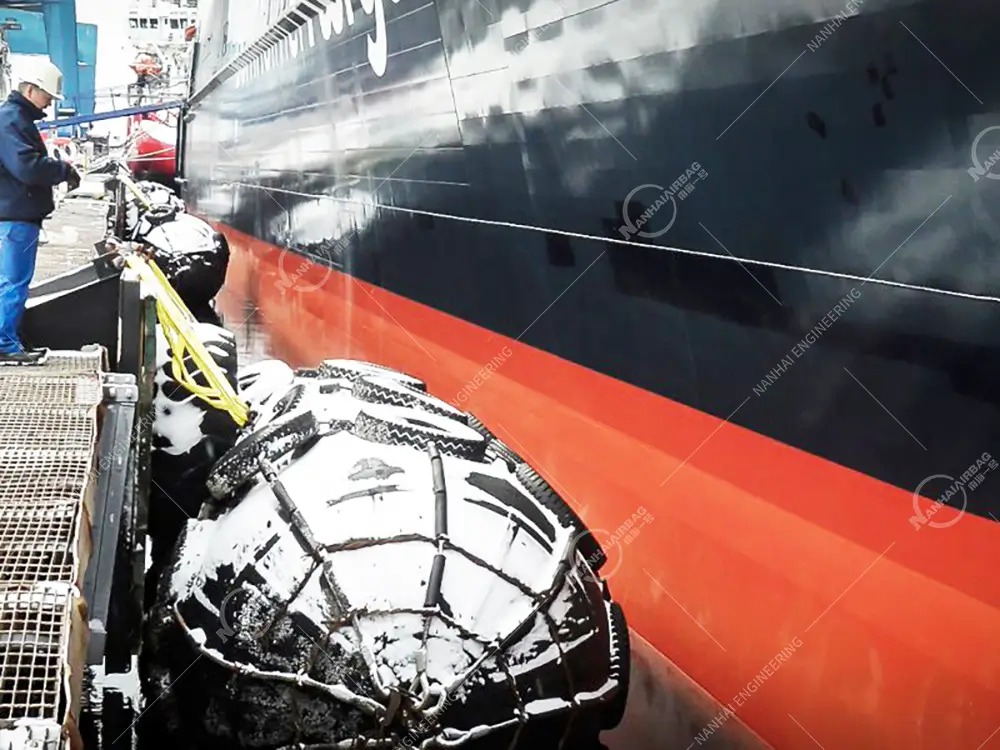
1. Low-Temperature Rubber for Pneumatic Fenders
Standard pneumatic fenders using normal rubber show a clear performance drop below around −20°C.
Cold-climate pneumatic fenders use specially formulated low-temperature rubber with:
- A lower glass transition temperature (Tg),
- High flexibility in extreme cold,
- No significant stiffening or loss of elasticity as temperature drops.
For example, NANHAI low-temperature pneumatic fenders are designed to maintain stable elasticity and energy absorption even at −50°C, with no significant performance degradation.
2. Polyurea Coating for Foam Filled Fenders
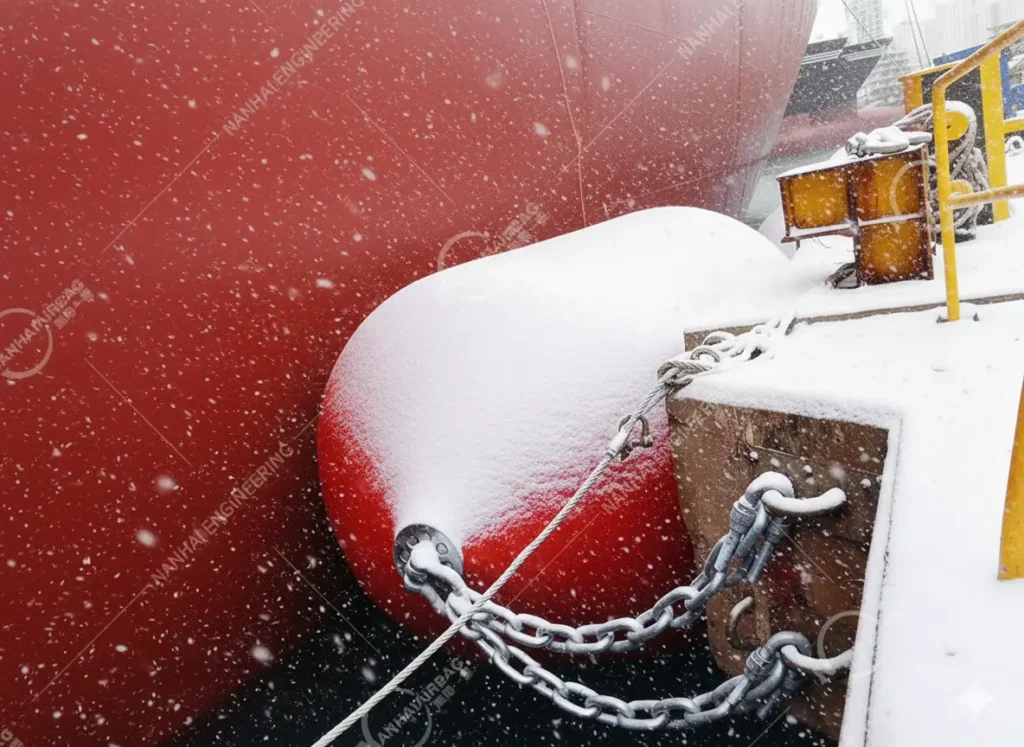
Foam filled fenders are more stable in cold climates because they do not rely on internal gas pressure, but their outer protective layer is critical.
Compared with traditional PU coatings, polyurea coatings offer:
- Excellent low-temperature flexibility and crack resistance (low-temperature Tg typically around −50°C),
- High abrasion and impact resistance with no peeling during thermal cycling,
- Outstanding waterproofing, salt-spray resistance, and UV resistance.
This makes polyurea an ideal protective coating for foam filled fenders in icy, high-wear, and low-maintenance environments.
3. System-Level Cold-Climate Design
In addition to materials, the full fender system must be adapted:
- Air pressure compensation for temperature changes,
- Low-temperature-rated valves, flanges, chains, and accessories,
- Structural designs that account for thermal contraction and prevent loosening or leakage.
Even if the fender body is cold-resistant, system “weak points” can still cause failure.
Recommended Fender Solutions for Different Cold Scenarios
Ice Zones and Extreme Cold Ports
Recommended: Low-temperature pneumatic fenders with special cold-climate rubber formulations, focusing on elasticity, energy absorption, and long-term reliability.
Winter Ship-to-Ship (STS) Operations
Ship to ship frequent impacts and changing conditions require high flexibility. Pneumatic fenders maintain soft, adaptive buffering behavior even in cold weather, helping reduce local stress and wear.
Floating Platforms and Temporary Berthing Points
Recommended: Foam filled fenders with polyurea coatings. These are ideal for long-term exposure, limited maintenance access, and high durability requirements.
Implementation Notes
- Conduct low-temperature testing and type approval (e.g., −30°C, −40°C, −50°C conditions).
- Avoid rapid temperature changes during winter transport and storage to prevent internal stress.
- Regularly inspect pressure, surface condition, and connection hardware to identify risks early.
Conclusion
Low-temperature fender solutions are not about simply making fenders bigger or thicker. They are about engineering the right materials, coatings, structures, and systems for cold environments.
Only by designing specifically for cold conditions can marine fenders remain stable, reliable, and safe in extreme climates — protecting both vessels and port infrastructure over the long term.
FAQ
Q1: Why do standard marine fenders fail in cold environments?
Because conventional rubber and coatings become stiff or brittle at low temperatures, which reduces energy absorption and increases the risk of cracking and damage.
Q2: What temperature range are low-temperature marine fenders designed for?
Typically down to −40°C, and for special cold-climate designs, even down to −50°C.
Q3: Why is polyurea better than PU for cold-climate foam fenders?
Polyurea maintains flexibility at very low temperatures, resists cracking and peeling, and provides superior abrasion, impact, and corrosion resistance.
Q4: Are system components as important as the fender body?
Yes. Valves, chains, flanges, and connections must also be low-temperature rated, otherwise they can become the weakest link in the system.
Q5: Do cold-climate fenders require more maintenance?
Not necessarily, but regular inspection is important because cold conditions increase stress on materials and connections.